Yesterday we stood in front of a farm that was, on paper, exactly what we’ve been looking for. And by the end of the tour we were left with more questions than answers. Let me back up.
Two days, four properties
On Tuesday, the three of us (me, Jason, and Niki) went on our first real estate outing for Start Small Farms. None of us had done this before, not for something like this, and it turns out that touring places you can’t stop imagining yourself in is its own kind of education.
The first place was mixed-use commercial. Four or five rentable spaces, right on a busy road. Nothing about it said “farm” or “rural.” One unit was a yoga studio, one was a thrift shop, and one was a sign shop doing car wraps and realtor signage. The empty room had the exact energy of that liminal-space Backrooms meme. There was also a temperature-controlled indoor garage for luxury cars, and I’ll be honest, my brain immediately went “we could make this work.” (My brain says that a lot. It’s a problem and a gift.)
The second was a genuinely gorgeous renovated barn with a little owner’s apartment. But the barn itself had no heating or cooling, which in July means a sauna, and the lower level that could have become a commercial kitchen had ceilings low enough that Jason had to duck. At about an acre and a half, there wasn’t room for the private, outdoor, nobody’s-nosy-neighbor-is-watching kind of events we keep picturing.
The third used to be a tasting room for a winery, in original buildings from the late 1700s. Seventeen acres, a weird indoor-outdoor room with a goldfish pond, and, how do I say this kindly, a powerful history of dogs. Jason lit up imagining artist-retreat yurts scattered across the back acreage.
None of them were it. But looking at three very different wrong answers made the right question a lot clearer.
Then, yesterday
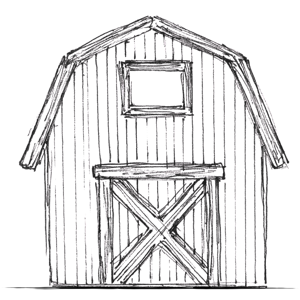
Turnkey perfect, Niki called it. A beautiful farmhouse in great shape. Almost eight acres of flat, well-kept land. Two barns: a newer restored bank barn with a lower level the earth keeps naturally cool, and an older barn for animal supplies and equipment. A cute she shed. A garden plot. A small greenhouse. If we wanted, a ready-to-go pasture with goats and a mini donkey included. If you drew Start Small Farms as a real place, it might look a lot like this.
And then the buts. The house sits right on the road, in a stretch of newer homes without much of the history or charm we’re drawn to. Across the street is a big open field that is, for now, a big open field. Someday it could be another housing development. Or a warehouse. Who knows.
It’s zoned residential but runs as an event venue: weddings, photo shoots, the occasional other thing. And touring it as people who might actually run events there, we kept noticing the hard parts. The barn isn’t climate controlled, so a 100-degree day like yesterday makes it unusable. No kitchen. No bathrooms, which means renting porta potties (or one of those fancy restroom trailers) for every single event. It turns out running events out of a beautiful building is a lot harder than a beautiful building makes it look.
The thing we didn’t expect to realize
Standing in a wedding venue, we realized we probably don’t want to host weddings.
They make money, yes. But they’re enormous, and you’re carrying the weight of someone’s biggest day. Niki said it best: it could be fun, but it’s a lot of stress to be responsible for the most important day of a near-stranger’s life. She’s in if we ever need it for revenue, but the creative side is the real dream. Jason did the math out loud: an event with a hundred people at $50 a head brings in about what you’d make hosting one wedding, and four people paying for a few nights on a writing retreat beats that with a fraction of the chaos. His conclusion has quietly become a house motto: figure out the fun events first, then figure out the money.
So here’s the vision taking shape. Smaller events we’d genuinely want to attend ourselves. Jason can already see a writers’ retreat here, bedrooms kept as bedrooms. I can see a women’s day retreat, part group and part quiet one-on-one. A kids’ day camp, obviously. Room for our own messes and supplies and half-finished ideas. And the gift boxes and handmade goods quietly funding the whole thing over time.
Our rule of thumb is simple: for any event we host, one of us, or someone we love, has to actually be part of it. Weddings are wonderful. We’ll have plenty in our own family and friend circle to throw ourselves into. We just don’t need to sell them to strangers.
So would we buy it?
Honestly? Probably. Of the four, it’s the closest to the dream, and buying it would get us there in record time. Like, two-days-into-looking record time.
But for a dream that’s been brewing for ten years (or really, most of my life), we don’t have to rush it. We can start small.
If we ever did make an offer, we’d walk in with a long list of questions, because a place like this isn’t just a property, it’s a whole business. And we’d want to do right by the current owner, who by every appearance is a genuinely community-minded person. And we’d want to do right by every couple who’s already booked their day there in the months ahead.
The consensus at the Coleman house right now: stay patient, stay true to the creative part, and don’t let “almost perfect” talk us out of “actually right.” We’re not getting our hopes up. We are getting our vision clearer. Our realtor is riding the wave, still not entirely sure what this weird little venture is going to become.
Neither are we, completely. That’s the fun part. We’re figuring it out in public, one property tour at a time.
— Kim